
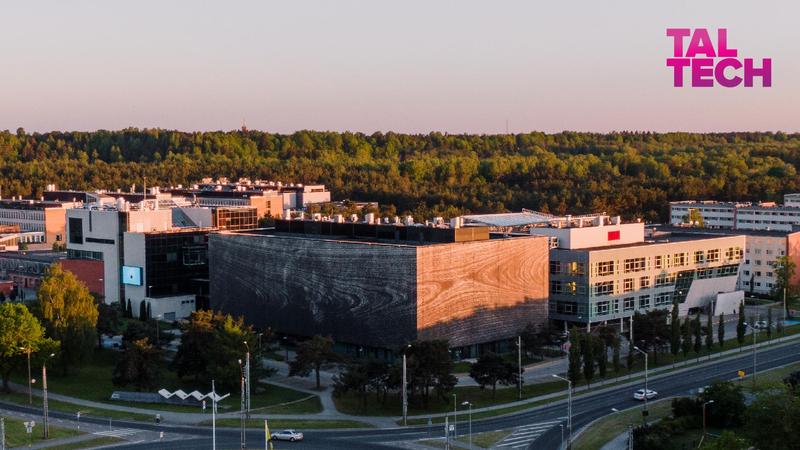
We invite applications for a PhD position focused on developing transferable, physically consistent and uncertainty-aware models for smart-building energy systems. The project will use real-world data from TalTech campus buildings and experimental facilities to develop models. The successful candidate will be based at Tallinn University of Technology and jointly supervised by Technical University of Darmstadt Germany.
The project will address the following key areas:
This PhD project focuses on developing physics-informed and transferable models for predicting the thermal and energy behaviour of smart buildings. Existing data-driven models often require large amounts of building-specific data and may generate predictions that violate physical principles. The project will address these limitations by combining physical knowledge with machine learning and developing models that can be efficiently transferred to previously unseen buildings. The developed models will be validated using data from TalTech campus buildings. The models will provide a reliable foundation for energy forecasting and learning-supported model predictive control.
Key research questions include:
How can physical building and HVAC constraints be incorporated into machine-learning models?
How can models trained on multiple buildings be efficiently transferred to a new building using limited calibration data?
How can building metadata, occupancy, weather and operational information improve model generalisation?
How can prediction uncertainty and out-of-distribution operating conditions be identified and quantified?
How can the developed models support safe, reliable and computationally efficient building-energy control?
The candidate should submit a short essay explaining their motivation for the PhD topic and the research questions or directions they would be most interested in exploring. The candidate may build on the listed research questions or propose related questions and approaches.
Responsibilities and (foreseen) tasks:
Develop hybrid physics-informed and data-driven models for building thermal and energy dynamics.
Investigate grey-box models, physics-informed neural networks, structured Gaussian processes and neural state-space models.
Integrate multi-source data, including energy consumption, indoor climate, weather, occupancy and building metadata.
Develop uncertainty-quantification and model-reliability assessment methods.
Validate the models using TalTech campus datasets and experimental building facilities.
Develop reusable model interfaces suitable for integration with model predictive control and explainable-AI methods.
Produce open-source software, benchmark datasets and reproducible research workflows.
Publish results in high-impact journals and present them at international conferences.
Applicants should fulfil the following requirements:
Master’s degree in electrical engineering, control engineering, civil or energy engineering, computer science, applied mathematics, or a related discipline.
Strong background in machine learning, system modelling, data analytics or control systems.
Understanding of time-series analysis, dynamical systems and/or building-energy systems.
Proficient programming and data-analysis skills, preferably in Python, MATLAB or Julia.
Proficient English-language skills, at least CEFR level C1.
Excellent analytical, mathematical and problem-solving abilities.
Capacity to work both independently and as part of an international and interdisciplinary research team.
Willingness to participate in research visits, joint experiments, training activities and relevant organisational tasks.
The following experience is beneficial:
Experience with physics-informed machine learning, scientific machine learning or hybrid modelling.
Knowledge of transfer learning, meta-learning or few-shot learning.
Familiarity with deep-learning frameworks such as PyTorch, TensorFlow or JAX.
Experience handling real-world sensor, weather or building-management-system data.
Experience with system identification or building energy modelling
.
Understanding of HVAC systems and building physics.
Previous scientific publications or open-source software contributions.
We offer:
A four-year PhD position in an international and interdisciplinary research environment at TalTech, working with the FinEst Centre for Smart Cities and the Nearly Zero Energy Buildings Research Group.
A fully funded doctoral position undertaken within the Horizon Europe-funded SMARTWIN project.
Joint supervision by TalTech and a co-supervisor from the Technical University of Darmstadt (TUDA), with opportunities for research stays at TUDA, collaboration with École polytechnique fédérale de Lausanne (EPFL), and participation in international conferences.
Supervisors:
Main supervisor: Adjunct Professor Avleen Kaur Malhi, Office of Vice-Rector for Research: FinEst Centre for Smart Cities
Co-Supervisor: Senior Researcher Tuule Mall Parts, School of Engineering: Department of Civil Engineering and Architecture: Nearly Zero Energy Buildings Research Group
Tallinn University of Technology (TalTech) is an international scientific community with approximately 9,000 students and 2,000 employees; it is one of the largest universities in Estonia, the leading EU country in digitalisation. The university's strengths are broad multidisciplinary study/research interests, a modern research environment, and strong collaboration with international educational and research institutions. TalTech is aiming to be an organisation leading the way to a sustainable digital future.
The Department of Civil Engineering and Architecture at Tallinn University of Technology (TalTech) is an interdisciplinary academic and research unit within the School of Engineering. The department’s Nearly Zero Energy Buildings Research Group develops technical solutions, control approaches and assessment methods for high-performance buildings. It collaborates across architecture, construction, energy systems, data science and artificial intelligence. Its research has contributed to national and European building-energy methodologies, regulations and practical solutions developed with industry and the public sector. The department participates actively in national and international research networks and EU-funded projects, providing a strong environment for interdisciplinary doctoral research in smart-building energy management, artificial intelligence and control.
For information about the admission process, please visit the PhD Admission homepage
Applications can be submitted from 04.11.2026 to 05.12.2026
For further info, please contact:
Dr. Avleen Malhi Avleen.malhi@taltech.ee and Tuule Mall Parts tuule.parts@taltech.ee